
Veasey Conway/Harvard Staff Photographer
Health
Demystifying migraine
‘It’s not an imagined headache, and it’s not a mild condition,’ says Michael Moskowitz, Brain Prize recipient for his dogma-defying research
Part of the
Profiles of Progress
series
About 15 percent of people worldwide suffer from migraine, a neurological condition that can cause headache, nausea, visual disturbances, and sensitivity to light and sound.
After stroke and neonatal brain injuries, migraine is the third-highest nerve-related cause of years lost to disability worldwide.
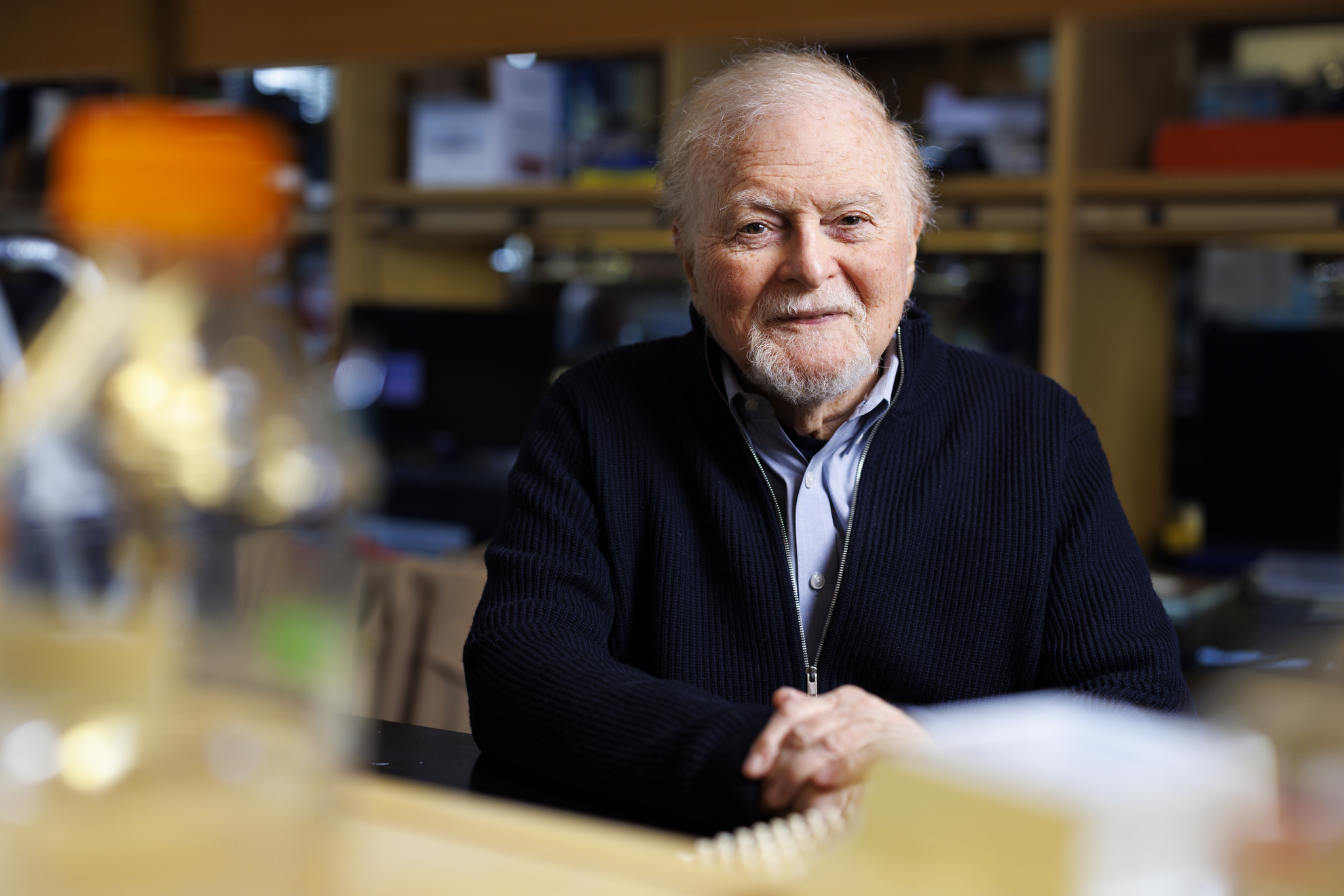
The condition is also undertreated and poorly understood, says Michael A. Moskowitz, Harvard Medical School professor of neurology at Mass General. Moskowitz has made multiple discoveries that have revolutionized thinking about the condition, deepened knowledge about why some treatments work, and led to new treatments that are available and prescribed now.
Moskowitz’s interest in neurology began early. At 14, he worked as a messenger in a hospital for patients with chronic neurological diseases near his family’s home in New York City, and was shocked by what he saw. “I could not comprehend how the brain could so easily betray the body,” he said.
When he began his career in the early 1970s, migraine was still poorly understood. Images of the brains of patients came back totally normal: On paper, there was nothing wrong.
“When I first started in the field, many people believed that migraine was a psychological problem,” said Moskowitz. “But it’s not an imagined headache, and it’s not a mild condition.”
His first step, when he was a postdoctoral fellow and junior faculty in the Harvard-MIT Program in Health Sciences and Technology, an inter-institutional collaboration between Harvard University, Harvard Medical School, and MIT, was to dive into the literature.
“I don’t know how many nickels I dropped in the Xerox machine at the Countway Library, but quite a few,” he said.
“When I first started in the field, many people believed that migraine was a psychological problem.”
He found that no scientist had yet mapped the nerves carrying sensation from the circle of Willis, a network of arteries in the innermost layer of the meninges that supply blood to the brain. The brain itself doesn’t register pain, but the meninges, the brain’s three-layered covering, do. It seemed a promising place to start.
So using a novel polymer-based technology developed in partnership with MIT chemical engineer Robert Langer, Moskowitz showed that nerve fibers that wrap around the circle of Willis travel back to the brain via the trigeminal nerve, which also carries sensation from the forehead, where headaches are often felt. His lab then found that these nerves contain and release neuropeptides, setting up a cascade that causes meningeal inflammation and other harmful effects.
It was a stark departure from the previous belief about migraine, which was that the condition was purely caused by the dilation of blood vessels.
In later research, Moskowitz demonstrated that classical migraine drugs called ergots and triptans acted in a completely different and unexpected way than had been assumed: Rather than constricting blood vessels, the drugs blocked those harmful neuropeptides from being released from nerve fibers in the first place.
“That changed 100 years of dogma about how the ergots worked,” Moskowitz said. It also led to a new class of drugs that blocked neuropeptide release without vessel constriction In addition, it led to the development of drugs and antibodies that block the action of CGRP, a major neuropeptide in this pathway; those drugs are still in use today. Other neuropeptides discovered through his research are providing promising leads for future migraine therapies, said Moskowitz, who in 2021 received the Brain Prize for his contributions to migraine research.
Building on the breakthrough, his lab began to look for the trigger that caused the release of peptides in the first place. They identified cortical spreading depression, a slow-moving tsunami of electrical and chemical changes in the brain. As the wave progresses, it can trigger migraine’s varied symptoms. For example, the migraine’s classic visual aura occurs as the chemical and electrical changes move through the brain’s visual cortex.
Moskowitz’s research is also focused on the study of stroke and its potential neurovascular targets. In 2024, he and his chief collaborator, Matthias Nahrendorf, an HMS professor of radiology at Mass General, were awarded a Javits Award, a prestigious seven-year research grant, from the National Institutes of Health. Along with another collaborator, Charles Lin, an HMS professor of dermatology at Mass General, they are following up on new discoveries showing that the skull bone marrow and its blood-forming inflammatory cells contribute to the health of the meninges. The findings could impact a variety of neurological diseases, including stroke, Alzheimer’s disease, and multiple sclerosis.
“My research has been 98 percent funded by the NIH over the course of my career,” Moskowitz said, expressing gratitude for the federal partnership that allowed bench-to-bedside medicine to flourish. “I can say with great confidence that if it weren’t for the NIH, we definitely wouldn’t have these new migraine drugs that block headaches.”