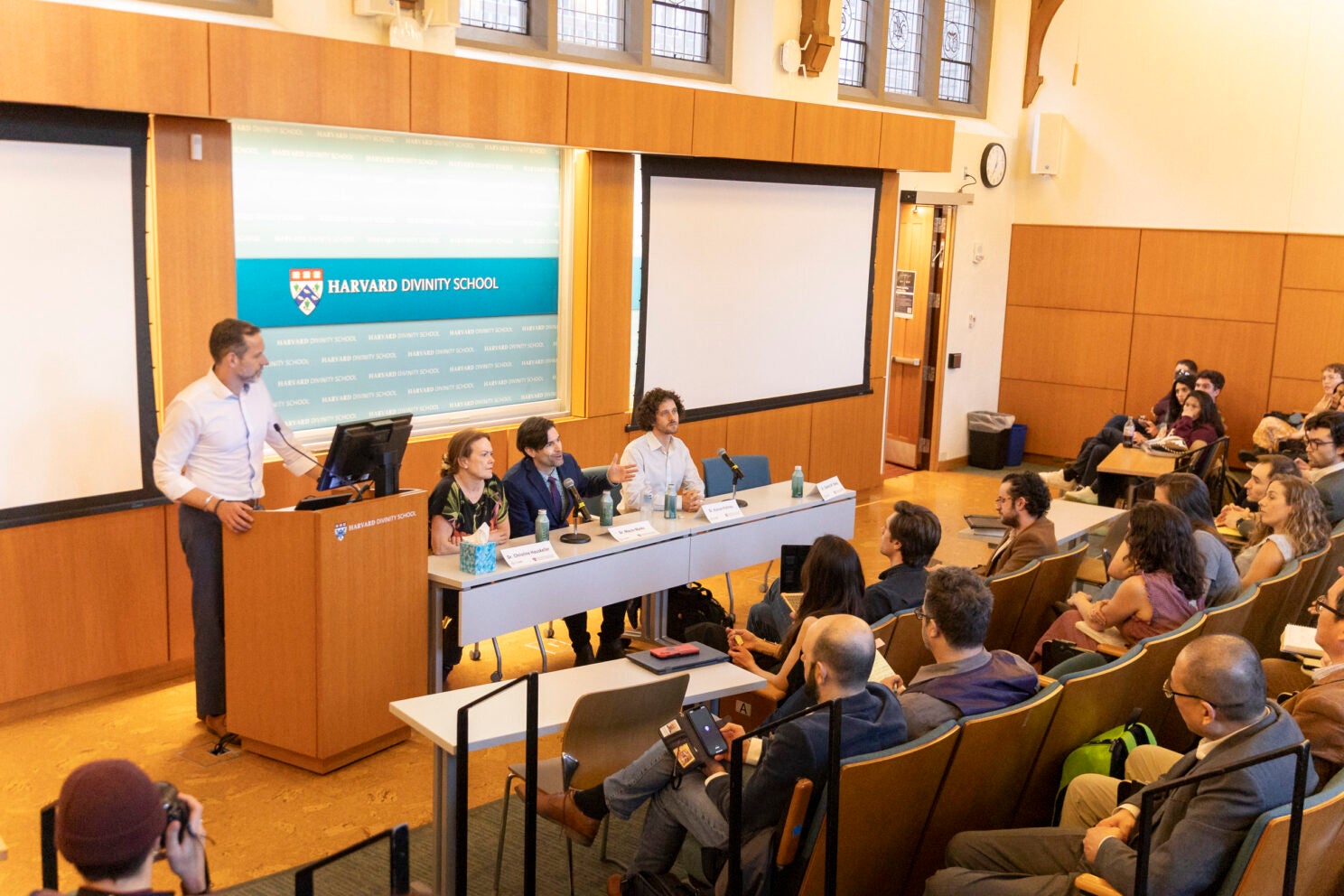


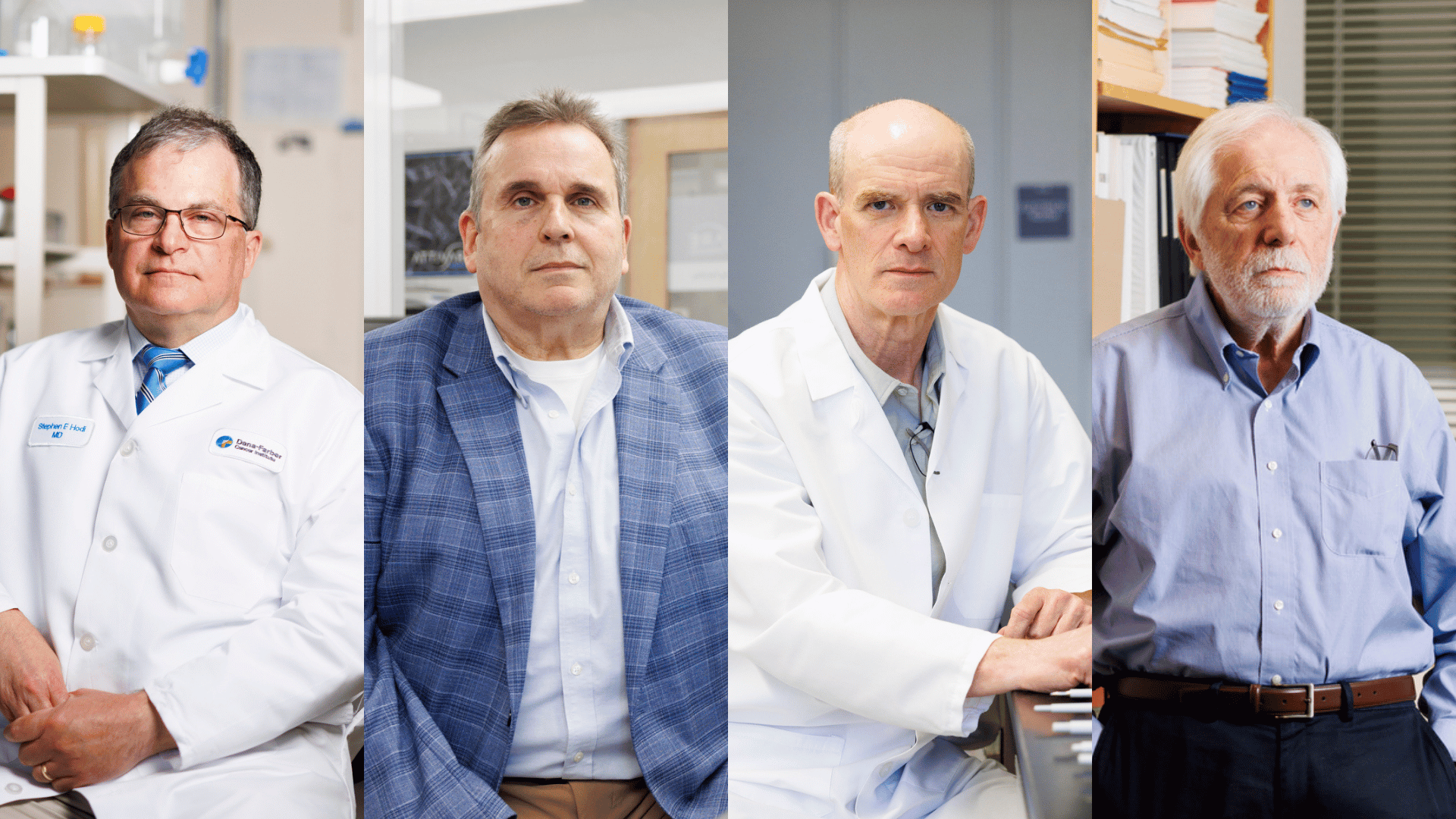
F. Stephen Hodi, Ed Doherty, David Mooney, and Jerome Ritz.
Veasey Conway/Harvard Staff Photographer; Niles Singer/Harvard Staff Photographer
Health
Tracing evolution of vaccine for cancer, malaria
Technology born out of Harvard labs shows power of collaboration, how path to development seldom follows straight line
For Ed Doherty and his collaborators, the vaccine project has been a long haul.
“It’s going to kill me, but it’s the best thing I’ve ever done,” joked Doherty, co-founder of Attivare Therapeutics, an anticancer startup born out of Harvard labs amidst the pandemic’s disruptive swirl.
Attivare’s technology essentially creates tiny “factories” in the body where immune cells learn to recognize tumor cells and attack them. The process has yielded promising results in cancer clinical trials and been extended to fight infectious diseases, including a COVID vaccine created while the team was still at Harvard but too late in the pandemic to be part of the global response.
And in December of 2025, the Natick, Massachusetts, company received a $6.6 million grant extension from the Gates Foundation to continue to develop a vaccine for malaria, one of the world’s deadliest infectious diseases.
The story of the evolution of the vaccine project illustrates the potential power of different teams — basic scientists, translational scientists, and clinical medical researchers — working collaboratively. It also highlights how the path to discovery is seldom a straight line.
In fact, the story of WDVAX, as the cancer vaccine was initially called, doesn’t begin at the lab bench and move directly to patient bedside. Instead, the project wandered from bench to bedside, then back to the bench. There, additional improvements led Doherty to leave the Wyss Institute and establish Attivare, which is seeking once again to get the vaccine to patients.
Ed Doherty.
Niles Singer/Harvard Staff Photographer
And Doherty wasn’t working alone.
Attivare’s tiny “factories” are made of a porous biomaterial via a process pioneered in the lab of David Mooney, Robert P. Pinkas Family Professor of Bioengineering in the Paulson School of Engineering and Applied Sciences. It was further developed in Mooney’s lab on Harvard’s Longwood campus, at the translation-minded Wyss Institute for Biologically Inspired Engineering.
“There’s a two-way street here,” said F. Stephen Hodi, a Harvard Medical School professor of medicine at the Dana-Farber Cancer Institute who ran the clinical teams during the WDVAX trial. “Having these teams and connections going from bench to bedside, back to bench and such, I think will speed up our ability to help patients.”
“Having these teams and connections going from bench to bedside, back to bench and such, I think will speed up our ability to help patients.”
F. Stephen Hodi
It’s been a long road for Doherty and colleagues. It’s been perhaps a longer road for the technology itself, which grew out of advances in Mooney’s lab at the University of Michigan in the late 1990s.
There, he developed a gas foaming process to create porous structures to house or transport proteins. He mixed in small particles of salt and sugar, which dissolve when washed with ordinary water, leaving behind a porous scaffold made of the biodegradable material used in medical sutures, which releases its contents as it slowly degrades.
At that early stage in the technology’s development, the idea was to use the device in tissue engineering, during which scientists alter cells to correct genetic or other defects and then implant them in the patient to replace the patient’s own defective cells.
Mooney envisioned using the structure to slowly release proteins known as growth factors at the transplantation site, which would encourage the growth of transplanted cells.
The idea of a cancer vaccine came later, after Mooney moved to Harvard in the mid-2000s, in discussions with Ph.D. student Omar Ali, who had followed Mooney to his new post.
David Mooney.
Niles Singer/Harvard Staff Photographer
“We developed this as a way of gently encapsulating proteins in this polymer,” Mooney said. “When we started thinking about vaccines 10 to 15 years later, we realized this would be a nice technique to use.”
In the early 2010s, Mooney became a core faculty member at the Wyss Institute for Biologically Inspired Engineering. He discussed the idea with Glenn Dranoff, a cancer vaccine expert and then a Wyss associate faculty member.
“We started talking with Glenn, who was then co-leader of Dana-Farber Cancer Institute’s Cancer Vaccine Center. He had been developing cancer vaccines and putting them in clinical trials for probably a couple of decades by that point in time,” Mooney said. “He basically said, ‘We should do a clinical trial.’ And I said, ‘We should do a clinical trial?’ And he said, ‘Yeah, we should do a clinical trial.’”
The researchers launched into mouse studies that would ultimately total nearly 100. Though they would take the next seven to eight years to complete, they’d also confirm Mooney and Glenn’s hunch that the technology had the potential to be a potent tool in oncologists’ anticancer arsenal.
“We were able to generate really robust immune responses in a variety of models of different types of solid tumors,” Mooney said. “We noticed that the strategy was able to not just halt cancer progression in these mouse models but also cause complete regression for a sizeable fraction of the animals. That was a very encouraging result and suggested that this was a strategy that really robustly altered the immune response against these cancers.”
But before the human trial of WDVAX could kick off in 2013, there was work to do by the Wyss Institute’s translational scientists, led by Doherty. He had worked with biomaterials in industry for 25 years, and saw his task as standardizing the technology and making it replicable, a requirement for any medical product.
He also loaned his expertise in regulatory affairs to guide the clinical trial application through the Food and Drug Administration.
Doherty and his team of 18 experts in quality control, manufacturing, and analytic chemistry worked with Dranoff and Hodi at Dana Farber, which led the clinical side of the trial, and Jerome Ritz, HMS professor at Dana-Farber’s Connell and O’Reilly Families Cell Manipulation Core Facility, which created the biological materials needed.
Jerome Ritz.
Veasey Conway/Harvard Staff Photographer
Doherty’s team fine-tuned the device and its immunologic approach. They built equipment that could be transferred for the trial to the CMCF, which manufactures genetically engineered cells for patients enrolled in early phase clinical trials. The CMCF adapted the process used in mice into one that could be used in humans and then in manufacturing WDVAX.
“This is all about reproducibility and safety,” Doherty said. “In order to go into humans, they’re going to demand that you demonstrate that you know the pitfalls, you know all the problems, so that when you put it into patients you suddenly don’t say, ‘We didn’t think that would happen.’”
The WDVAX trial, the first to test a personalized, biomaterial-based vaccine, was a Phase 1 trial of 21 patients with advanced melanoma that had spread throughout the body.
Since the main purpose of a Phase 1 trial is to evaluate safety, its patients were enrolled one after the other. That slowed progress but ensured any negative effects would be revealed and addressed before it was given to another patient.
Clinicians biopsied the subjects’ tumors, divided the biopsied tissue in two, then sent half to the lab for clinical analysis and half to technicians in the CMCF to make the vaccine. CMCF technicians put the tumor cells through multiple freeze and thaw cycles, which broke down tumor cell walls and created a mix, called a “lysate,” of tumor proteins which were then incorporated into a WDVAX product for each patient.
The vaccine, inserted surgically under the skin, is a spongy tablet about the size of a baby aspirin. It is seeded with tumor lysate and molecules designed to spur an immune response. One, GM-CSF, attracts dendritic cells, key immune system cells that sound the alarm when they encounter antigens like the tumor proteins in the lysate. Others, CpG oligonucleotides, are adjuvants whose purpose is to activate the dendritic cells.
Once exposed to the lysate, the activated dendritic cells carry information about the tumor from the vaccine site to the patient’s lymph nodes. There, the cells encounter immune system T-cells, which the dendritic cells activate, sending them out to attack the tumors.
The study was detailed in the journal Cancer Immunology Research last July. Hodi and others involved in the trial said it went well, particularly with regard to its primary measure of safety and in researchers’ ability to consistently fabricate the vaccine.
In addition, the vaccine elicited an immune response, albeit one not as robust as in mouse trials, and 43 percent of patients exhibited stable disease.
But researchers were dissatisfied with the time it took to manufacture the vaccines, which had to be made individually for each patient, tailored to their specific tumor, and then tested. Taking weeks to create a vaccine was too slow for those with a fast-moving disease.
And, though the vaccine was determined to be safe, six deaths due to cancer progression were observed.
F. Stephen Hodi.
Veasey Conway/Harvard Staff Photographer
“After extensive training and developing detailed manufacturing procedures, we have to prove to ourselves and the FDA that we can do this successfully and consistently,” Ritz said. “So, we require a minimum of three ‘validation’ runs to manufacture vaccines that meet all release criteria but don’t go into the patients.”
The results left researchers thinking about ways to improve the vaccine to achieve the more dramatic results seen in mice.
One observation was that “checkpoint proteins,” which slow T cells’ attack on cancer cells, were upregulated, essentially being produced in greater quantities Perhaps, they said, the vaccine could be deployed in conjunction with checkpoint blockade therapy, which inhibits checkpoint proteins, and might free the T cell attack.
Another improvement was already being developed. An injectable version, which would be much easier to administer, was developed in Mooney’s lab in 2015. The injectable vaccine uses tiny silica rods instead of the foam-based bioscaffold. The rods, once inside the body, self-assemble into a bioscaffold that provides the same functional structures as the pores in WDVAX.
“If you think about doing this routinely, at clinics all over the place, we realized that we needed to make this injectable, consistent with how we get shots today,” Mooney said. “You get a shot, put a Band-Aid over it, and walk out the door.”
Enthusiasm about the technology’s growing promise prompted Doherty to start Attivare in 2021 with others from Wyss, including the former Director of Entrepreneurship Jessica McDonough, senior staff scientist Fernanda Langellotto, and scientist Ben Seiler.
Despite their enthusiasm, however, pandemic-era shutdowns created hurdles during the company’s launch.
“During the shutdown, I had left the Wyss and spent all of my time starting the company in my basement,” Doherty said.
Doherty and other co-founders endured, and Attivare eventually received $7.7 million in seed funding.
In the years since, they retuned the vaccine toward infectious diseases, with the Gates Foundation’s interest sparked by the vaccine’s ability to slowly release immune stimulating molecules over time, extending and boosting immune response.
The company is also working on an AI model to predict how individual patients’ cancers will respond, which will boost chances for therapeutic success.
Supporting it all, the funding environment finally seems to be improving, Doherty said. He hopes Attivare will attract $20 million to $30 million to support the AI-Oncology Program this year.
As he and colleagues at Attivare work toward a vaccine that will help patients, Doherty keeps in mind the practical vision of Wyss Institute founder Hansjorg Wyss, who believes promising technology shouldn’t languish in a lab.
“Mr. Wyss was a big advocate of the idea that really great technology that doesn’t get to the patient isn’t really great technology,” Doherty said.