

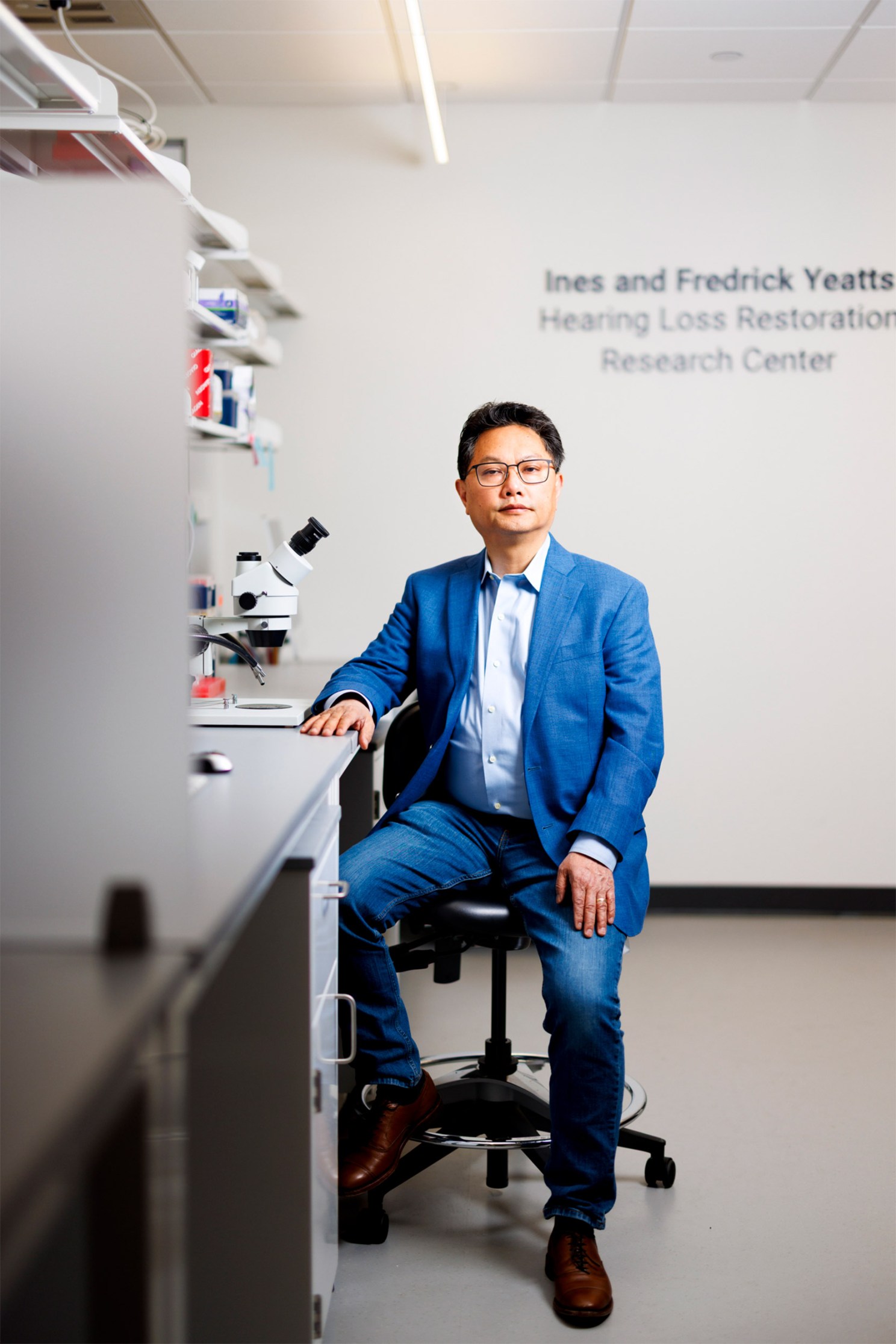
Zheng-Yi Chen.
Veasey Conway/Harvard Staff Photographer
Health
Hearing breakthrough holds up
Gene therapy yields lasting gains for patients with inherited deafness: ‘How well it worked is really amazing.’
An experimental gene therapy for people with an inherited form of deafness led to durable hearing improvements, a new study shows, with associated gains in patients’ ability to recognize speech.
The research corrected mutations in the OTOF gene, one of about 200 genes whose mutations are known to cause deafness from birth. Patients 18 and younger saw the strongest gains in hearing and ability to recognize speech. Adults receiving the therapy also saw improvements, though the effect was smaller. Overall, 90 percent of recipients saw their hearing improve, with half reaching normal levels by the study’s end at 2½ years.
“How well it worked is really amazing,” said Zheng-Yi Chen, co-senior author of the findings and a Harvard Medical School associate professor of otolaryngology-head and neck surgery at Mass Eye and Ear. “After 2½ years, more than half of them reached a normal level. They can hear a whisper. At that level, it’s better than mine.”
Worldwide, about 430 million people are affected by hearing loss serious enough to require rehabilitation, including 34 million children, according to the World Health Organization. Sixty percent of deafness in newborns has genetic causes, with mutation in the OTOF gene responsible for between 2 percent and 8 percent of cases. Babies with the OTOF mutation are completely deaf at birth, which affects speech acquisition and can hinder cognitive development.
Though the OTOF gene mutation is responsible for a relatively small proportion of inherited deafness, researchers said the platform developed in this work can be modified to correct other genes implicated in deafness. In fact, Chen said, the research team is already at work modifying the platform so they can treat deafness due to mutations in the GJB2 gene, the most common cause of genetic hearing loss.
The work, published April 22 in Nature, was conducted by researchers at Mass Eye and Ear, Harvard Medical School, and Fudan University, with additional trial sites in China. It builds on research published in 2024 that piloted the therapy among a small number of children. Those trials resulted in improvements rapid enough to surprise researchers and thrill parents, who saw their children go from completely deaf to responding to voices within just weeks.
“As follow-up time goes on, these children continue to bring us ongoing surprises,” said Yilai Shu, co-senior author of the study, whose team at Fudan University’s Eye and ENT Hospital led the study’s clinical work. “They progress from responding to sounds, to imitating speech, to speaking in short sentences, then to reciting poems and even singing. They always fill us with joy and encouragement.”
The therapy targets a condition called DFNB9, caused by the OTOF mutation. OTOF encodes the otoferlin protein, active in a snail-shaped structure in the inner ear called the cochlea. There, sound waves are translated into electric signals that, with the help of otoferlin, are conveyed to nerves and the brain. Without properly functioning otoferlin, electric pulses generated in the ear never make it to the brain.
Researchers said DFNB9 was an attractive target for therapy because it is caused by a mutation in a single gene, simplifying the repair. In addition, though the mutation disrupts signaling between the ear and the brain, cochlear cells are undamaged and ready to perform once the connection is restored.
To treat the condition, researchers injected a neutralized virus carrying a normal copy of OTOF into the fluid of the inner ear. The virus travels to the cochlea and expresses the OTOF gene in cochlear hair cells. That jump-starts production of normal otoferlin and restores the connection between the cochlea and nerves leading to the brain.
The study involved 42 participants carrying the OTOF mutation and ranging in age from nine months to 32 years. They were treated at eight trial centers across China.
Among those who responded to treatment, some reported hearing sound in as little as two weeks. Improvement was rapid over the first six weeks, plateauing around 26 weeks, with hearing recovery maintained through 2½ years. Though half achieved normal levels of hearing by that point, many of those who didn’t nonetheless saw significant improvement, Chen said, though hearing aids or other assistance might be required for day-to-day functioning.
That the effect endured so long was important, Chen said, because early lab experiments in mice saw the effect fade over time. Another key finding, he said, was that the treatment is safe, causing no serious adverse events among participants and no dose-related toxicity among groups that received three different doses.
While research will continue, Chen said that the team, whose work is supported by the Chinese and Shanghai governments and Fudan University, is beginning to explore regulatory requirements for the treatment to be approved for use in the clinic. That effort will begin in China. The hope is that expansion to other countries, including the U.S., will follow.
“The success of OTOF gene therapy marks a paradigm shift in treating hearing loss,” said Shu, a former postdoctoral fellow in Chen’s lab. “Going forward, personalized gene therapy approaches can be developed for congenital deafness caused by different gene mutations. These strategies will undergo preclinical efficacy and safety assessments to support their clinical translation.”
The scientists will continue to follow study participants through five years, said Chen, who also holds the Ines and Fredrick Yeatts Chair in Otolaryngology at Mass Eye and Ear. Several outstanding questions remain, including why 10 percent of participants didn’t respond to treatment, and why adults didn’t respond as well as youth.
“We have been working in this field for decades and there was nothing, nothing, nothing,” Chen said. “Then the treatment came out, worked really well, and now more trials are coming, some of which will be very successful. We’re looking forward to what the future will bring for patients.”