

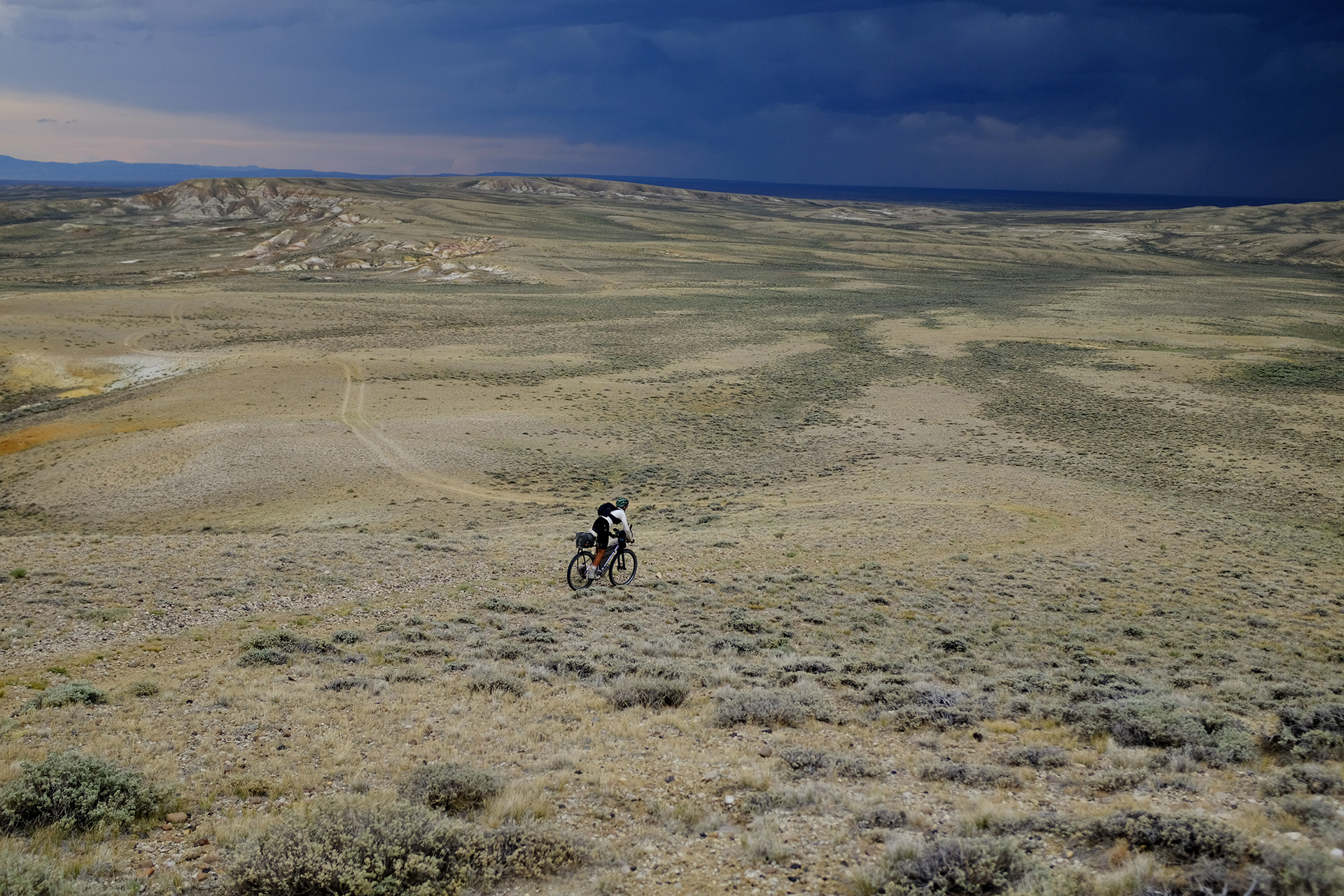
George Usmanov traverses Wyoming’s Great Divide Basin.
Photo by Chad Ament
Health
Part grueling race, part field study
From a bicycle seat, Harvard postdoc sees roadblocks facing rural medicine
George Usmanov did some unforgettable sightseeing this summer.
Over 25 days in June and July, he passed by ghost towns from both the 19th and 20th centuries and acres of forest, “completely charred.” He saw a river run yellow out of a Superfund site and the sun rise purple, thanks to a mix of “desert dust, mist from the Rockies, smoke that was coming in from wildfires.”
Typically, though, he had no one with whom to share those moments. Usmanov was taking part in the Tour Divide, widely regarded as the world’s most difficult bike race. It stretches over 2,700 mostly unpaved miles from Banff in southern Alberta, Canada, to the U.S.-Mexico border. And during his biking days, “about 70 percent of the time, I was entirely alone,” he said. “Even if you’re only separated from other racers by a couple of miles, the trails are extremely twisty and you don’t see them.”
This was in part a working holiday for Usmanov — and that kind of isolation was his object of investigation.
The Harvard Medical School research fellow in neurology at Massachusetts General Hospital is engaged in postdoctoral research on stroke — the nation’s fourth-most-common cause of death, and a condition in which every minute counts. The distances he covered are the same ones that separate some of the continental U.S.’s most isolated communities from centers of effective treatment.
Veasey Conway/Harvard Staff Photographer
Usmanov, 28, is not a doctor but a medical sociologist. His studies focus on “illness experiences”: how felt symptoms, social connections, and cultural norms encounter and shape treatment.
Stroke — with its various forms and subtle symptoms — is of obvious interest. Most stroke patients don’t feel pain. Instead, at onset, they experience “numbness, tingling, or some sense of disruption: you’re driving a car and suddenly you can’t turn the steering wheel. Or you’re using the TV remote and suddenly you don’t know how to change the channel,” Usmanov said.
Meanwhile, though, a clock has started ticking. “From that moment, parts of your brain are dying, at a rate of around 1.9 million neurons a minute,” Usmanov said.
In cases of acute stroke, the field of neurology has come to see the first 60 minutes after onset as the “golden hour”: If patients are examined and treated with an intravenous clot-busting drug like alteplase within that window, their odds of a full recovery improve dramatically. And clot-busting drugs can be used effectively for up to 4½ hours after a stroke’s onset.
The trouble, Usmanov said, is that “in the United States, the vast majority of people don’t get to a hospital in time, meaning they’re missing out on the most effective treatment.” (Mechanical thrombectomy — using a stent or vacuum to remove a clot physically — can be used up to 24 hours after onset, but it’s more invasive.)
To be sure, even most acute strokes are not lethal. But up to one-quarter of acute stroke survivors die within a year of onset, and survival and recovery rates vary greatly by stroke type, patient age, and the speed and type of treatment. In general, Usmanov endorses what has become a neurological maxim: that in cases of stroke, “time is brain” — meaning there’s an immense public health interest in shortening the gap between onset and appropriate treatment.
Usmanov noted that this country has made important strides toward making “golden hour” arrivals more likely — at least in theory. Individual medical centers have worked to shorten “door-to-needle” time: from intake to radiology and infusion. And not only can ambulances or helicopters shorten trips from homes to “stroke-capable hospitals,” there are more of those than ever before.
A team of Harvard researchers found that in 2019, 91 percent of Americans lived within one hour (by ambulance) of a center that could deliver alteplase; in 2011, it was just 80 percent. Further, they found an additional five percent can be reached by “telestroke”: a remote examination over video that has proven effective in lowering mortality and improving outcomes.
But one large region has remained stubbornly above the national average — the Mountain West, the “exact corridor” through which the Tour Divide passes, Usmanov said.
Usmanov has been an avid biker since his youth in Minneapolis. And this isn’t the first time he’s used his bike as a platform for rolling ethnography. During his graduate studies at Georgia State University, he took a similar ride to visit the informal communities that arise at campsites and RV parks across the Deep South.
“A bike is just an extremely useful and effective way to witness space, I think,” he said from his office in Somerville.
But in the Rockies, he found community harder to come by. There are fundamental problems of logistics — long distances, snowed-over mountain passes closed each year, unmaintained roads even in summer. Isolation is the rule even when ties are close. “The cost of seeing each other is so high,” he said. “Your daughter could live on the ranch next door, and that could still be an hour away.”
Moreover, the videoconferencing solutions behind telestroke — and much of post-COVID work and socializing — are not yet adapted to the heights Usmanov traveled. For about two-thirds of his ride, his phone had no connection at all, and simple sites could take minutes to load even when service was available.
Again — even with the benefit of sick leave, broadband internet, modern roads, and denser neighborhoods — Americans still tend to begin treatment too long after a stroke’s onset. So Usmanov has some justification for arguing that we need to focus on the first phase of stroke’s unforgiving timeline: between onset and calling 911.
For years, the public health establishment has tried education paradigms. Since 2013, they’ve used acronyms like F.A.S.T. to help laypeople recognize the telltale signs of stroke. But further study found that 30 days after an educational video, many participants had forgotten the symptoms, and that rates of timely 911 calling declined as well.
And in the Rockies, as in many lower-income precincts, there’s an element of class at play. “Generally, I met people who have done highly laborious work for years: construction, ranching, in the service industry,” Usmanov said. “And they tended to tell me similar things: ‘I’ve been in pain my whole life.’ ‘I broke something, but I had to work through it.’ Or ‘I experience weird sensations as part of my job: tingling, dizziness, numbness.’ Those are just the demands of the job — but they’re also symptoms of stroke.”
Usmanov in southern Wyoming.
Photo by Chad Ament
In January, Usmanov was the lead author of an American Heart Association paper finding that patients who were with family or trusted bystanders at onset tended to arrive at hospitals earlier than those who weren’t — or even than those who were with large crowds of strangers.
And his Great Divide ride underscored how much community matters in unforgiving terrain.
Some nights he’d camp serendipitously with other racers, for camaraderie as much as for safety. He made a “good friend” in one fellow racer, only to watch him drop out after developing nerve damage: the consequence of biking over bumpy dirt track with inadequate suspension.
And 500 miles from the finish line, Usmanov was contemplating dropping out after a crash and without water. “A rider named Bob passed me, gave me a little Gatorade, a kind of a pep talk, and went on his way.” (Only about half of the roughly 260 racers completed, with Usmanov middle of the pack.)
Usmanov’s ride had one last goal in mind: it served as a fundraiser for the Global Brain Care Coalition, a nonprofit that shares his ambition to find preventative care for neurological ailments. (It has raised $20,000 at time of publication.) And the Rockies taught him that there may be promising interventions to be made between individual vigilance and institutional change.
“Spouses, neighbors, church members can take blood pressure together, can discuss health behaviors — and that will do a lot more than this ad hoc approach, of one individual at a time,” Usmanov said. “We’re social creatures, and that’s where we have to target change.”
It’s a fitting takeaway for a sociologist after a long, lonely ride through the mountains.